
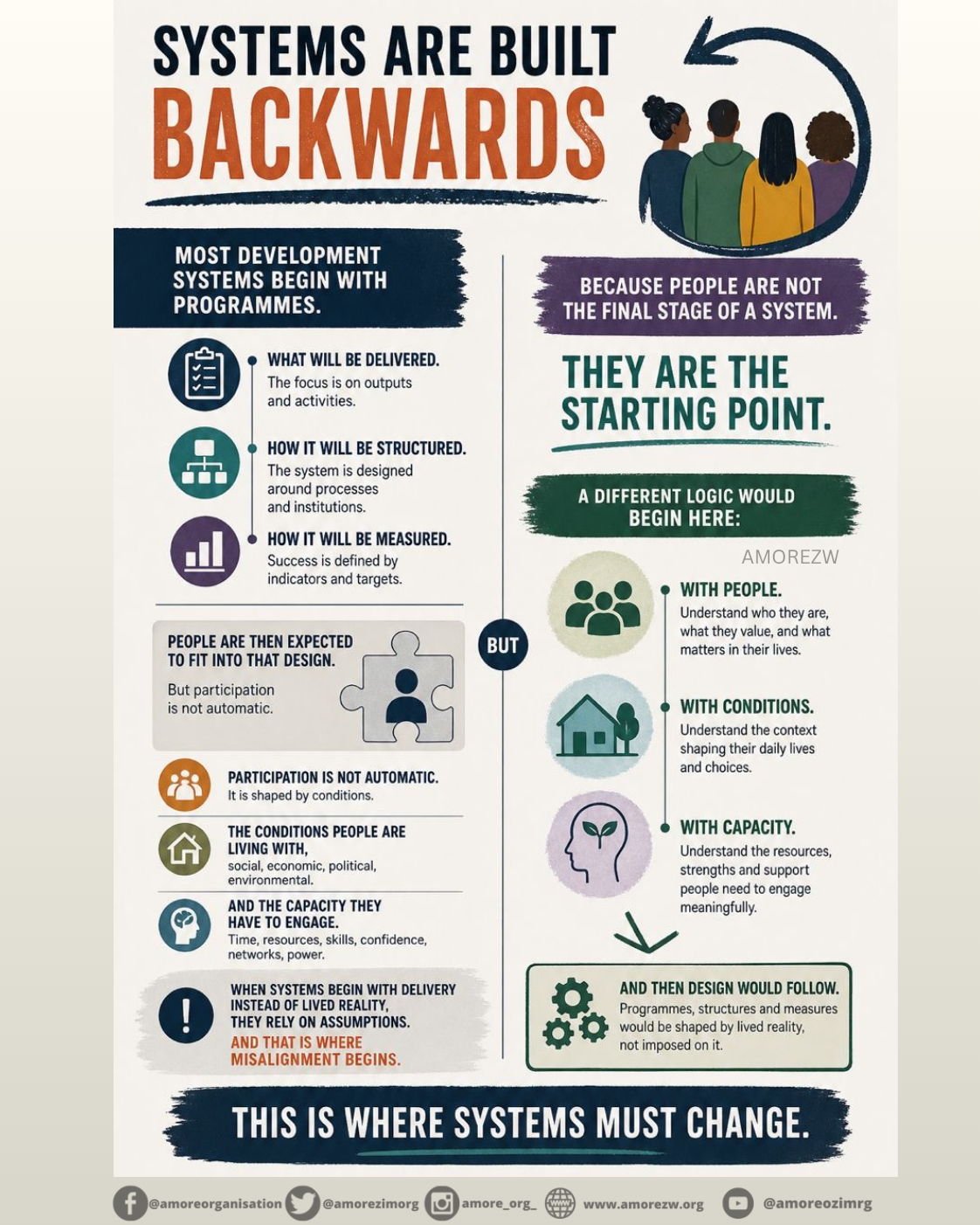
Human capacity as the centre of development system design.
Development systems are often designed around output targets to meet, timelines to follow, and resources to allocate. But systems do not succeed because they are well-structured on paper. They succeed because people are able to carry them.
When human capacity is not central to design, even well-intentioned interventions struggle to sustain impact. The issue is not only what is being delivered but also whether individuals and communities are in a position to engage with it fully and consistently over time.
What We Mean by “Capacity”
Capacity is often reduced to skills, training, or knowledge. While these matter, they represent only one layer of a more complex reality.
Human capacity includes the following:
- Psychological capacity – wellbeing, stress load, emotional resilience, and sense of agency
- Social capacity – relationships, support systems, and community cohesion
- Economic capacity – financial stability and ability to absorb shocks
- Institutional capacity – the extent to which systems enable or constrain participation
In this sense, capacity is not simply what people know or can do in ideal conditions. It is what they are able to sustain under the real pressures of daily life.
Why This Matters in Context
In settings such as Zimbabwe, development initiatives operate within layered and persistent pressures. Economic instability, migration, and constrained public services shape how people experience opportunity and participation.
This affects how interventions function in practice:
- Training programmes may reach individuals who are already mentally and emotionally exhausted
- Income-generating projects may assume financial risk-taking capacity that does not exist
- Psychosocial support may be introduced without continuity or integration into daily life
In such contexts, a familiar pattern emerges: strong initial engagement followed by gradual disengagement. This is often interpreted as lack of commitment. More accurately, it reflects a mismatch between system design and human capacity.
Designing Around Human Capacity
Designing around human capacity requires a shift in how development systems are conceptualised and implemented.
First, it requires attention to readiness and sequencing. Not all interventions can be effective at the same time or in the same order. Psychosocial stability, for example, is not separate from development outcomes it shapes whether other interventions can take root.
Second, it requires integration rather than fragmentation. Education, livelihoods, and psychosocial support should not function as isolated streams. They are interdependent and often reinforce or undermine each other depending on how they are designed.
Third, it requires a broader understanding of sustainability. Sustainability is not only financial or institutional. It is also human reflected in whether individuals are able to remain engaged, adapt, and continue participating over time.
AMORE’s Approach
At AMORE, work across education, economic empowerment, and psychosocial support is grounded in a simple premise: development is more effective when it is designed around lived human realities rather than assumed capacities.
This means recognising that:
- Psychosocial wellbeing is not an optional add-on, but a foundational condition for participation
- Economic opportunities must be designed with an understanding of real financial constraints and risk exposure
- Educational and empowerment initiatives must account for cognitive and emotional load, not just access
From this perspective, systems are not strengthened by adding more interventions. They are strengthened by designing interventions that people can realistically engage with and sustain over time.
Rethinking System Design
A shift toward human-centered capacity requires moving beyond output-driven thinking. It asks a more fundamental question: not only what are we delivering, but what conditions make delivery meaningful and sustainable for people?
Development systems are ultimately not self-sustaining structures. They depend on the capacities of the people within them. When those capacities are overstretched or overlooked, even well-designed systems lose effectiveness.
Rethinking development through this lens is not about doing less. It is about designing in a way that makes sustained human participation possible.
IN THE END, SYSTEMS ARE ONLY STRONG AS THE CAPACITY OF THE PEOPLE THEY ARE BUILT AROUND.