
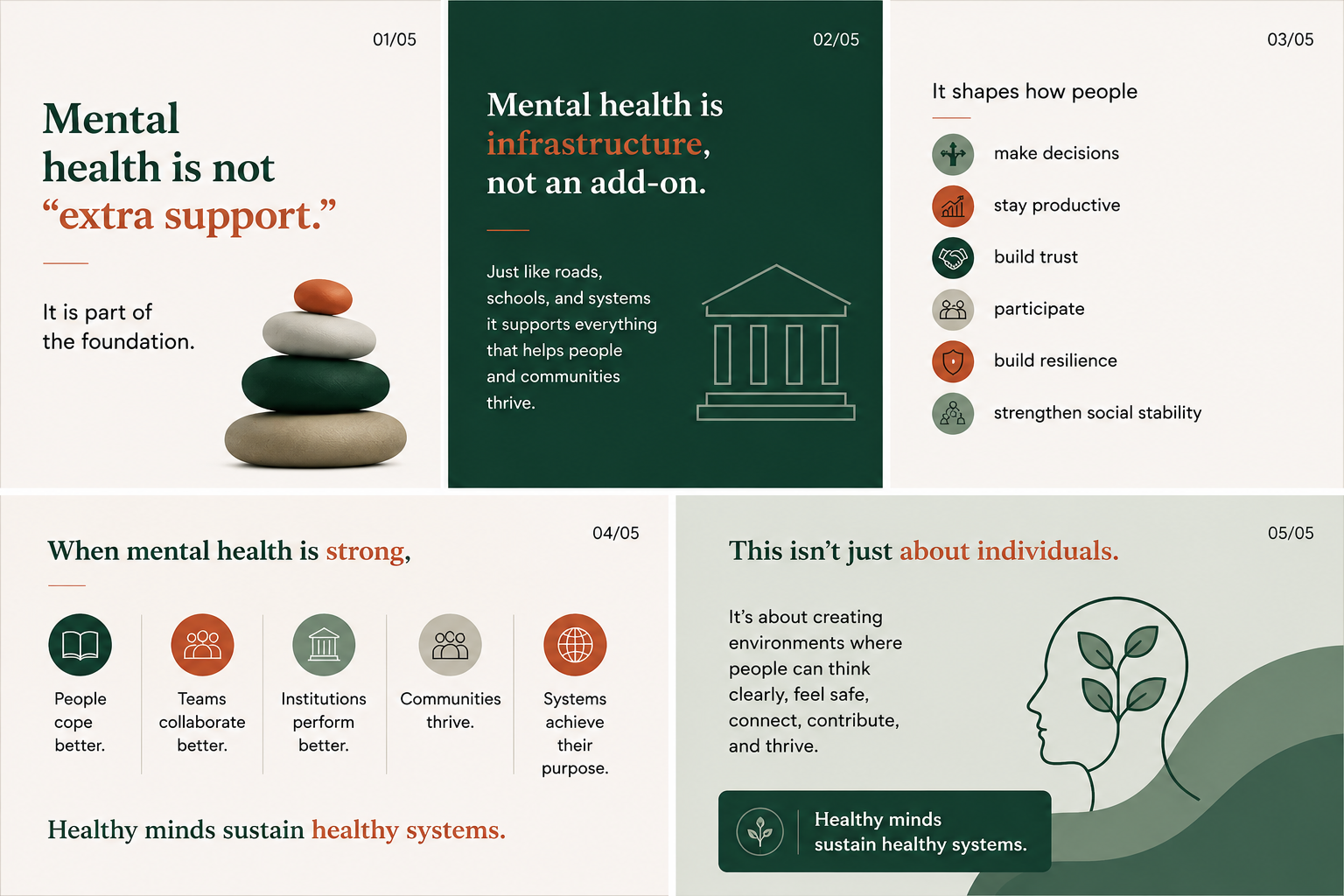
Why mental health should be understood as a foundational component of development systems, governance, and social resilience.
Mental health is frequently approached as a clinical concern or a matter of individual wellbeing. However, its influence extends far beyond the personal sphere. It affects how societies function, how institutions perform, and how communities adapt to pressure, uncertainty, and change.
At its core, mental health shapes human capacity:
• the ability to think clearly,
• maintain relationships,
• make decisions,
• participate economically,
• engage socially,
and respond constructively to adversity.
Since human systems are sustained by human behaviour, mental health inevitably becomes a structural issue.
Education systems rely on concentration, motivation, and emotional stability.
Workplaces depend on psychological wellbeing for productivity and collaboration.
Governance depends on social trust, civic participation, and institutional confidence.
Communities depend on resilience, cohesion, and collective coping mechanisms.
When mental health deteriorates across populations, the effects become visible beyond healthcare settings. Burnout increases. Social trust weakens. Participation declines. Polarisation intensifies. Institutional strain becomes more difficult to manage.
In this sense, mental health functions as a form of social infrastructure not always visible, but essential to the stability and sustainability of development systems.
Reframing mental health in structural terms encourages a shift away from reactive intervention alone toward long-term investment in human resilience, social wellbeing, and sustainable development.
Mental health is not separate from development.
It influences the very conditions that allow development to function.
#AmoreFramework #DevelopmentSystems #MentalHealthMatters